
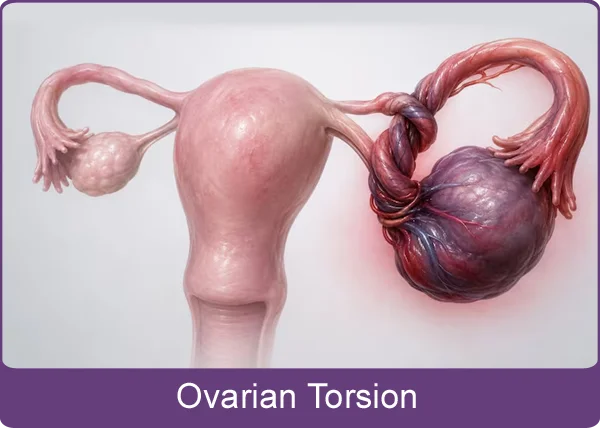
Ovarian Torsion
Ovarian torsion, also known as a twisted ovary, is a gynaecological emergency that occurs when an ovary twists around the ligaments and tissues that support it. This twisting can reduce or cut off the ovary's blood supply, potentially damaging ovarian tissue if treatment is delayed. Prompt diagnosis and urgent medical care are essential to protect a patient's health and, when possible, preserve ovarian function.
Dr. Richa Arora Miglani, Minimally Invasive Gynaecological and Robotic Surgeon, provides gynaecological evaluation and surgical care for conditions requiring specialized treatment. Patients seeking ovarian torsion treatment in Shalimar Bagh should be assessed urgently if they develop symptoms suggestive of ovarian torsion.
Treatment commonly involves surgery to untwist the ovary and restore its position. The exact approach depends on the severity of the twisting, the condition of the ovarian tissue, and the patient's clinical status.
Important: Sudden, severe pelvic or lower abdominal pain—especially with nausea or vomiting—requires immediate assessment at an emergency department. Do not wait for a routine appointment.
What Is Ovarian Torsion?
Ovarian torsion occurs when the ovary rotates around its supporting tissues, sometimes involving the fallopian tube as well. The twisting can obstruct venous and lymphatic drainage and may subsequently compromise the ovary's arterial blood supply.
It can occur at different ages, including during the reproductive years and, less commonly, before puberty or after menopause. Ovarian cysts or masses can increase the risk, but torsion may also occur in an ovary without a known mass.
Because blood flow can be affected, ovarian torsion is considered a time-sensitive condition. Prompt evaluation and treatment may improve the chance of preserving the ovary.
Symptoms of Ovarian Torsion
Symptoms can begin suddenly and may vary in intensity. Common signs include:
-
Sudden, severe pain in the lower abdomen or pelvis, often on one side.
-
Pain that may come and go or become progressively worse.
-
Nausea and vomiting accompanying pelvic pain.
-
Abdominal tenderness or discomfort.
-
Pain that may radiate to the back, flank, or groin.
-
Occasionally, mild or intermittent symptoms before a more severe episode.
These symptoms can resemble other urgent conditions, including an ectopic pregnancy, appendicitis, or a ruptured ovarian cyst. Medical assessment is necessary to determine the cause.
Causes and Risk Factors
Ovarian torsion can occur for several reasons. Factors associated with an increased risk include:
-
Ovarian cysts or masses: An enlarged ovary may be more likely to twist.
-
Enlarged ovaries: Ovarian enlargement from different causes can increase mobility.
-
Fertility treatment: Some treatments can enlarge the ovaries and increase torsion risk.
-
Previous ovarian torsion: Torsion can recur in some patients.
-
Pregnancy: Changes in ovarian size or the presence of a corpus luteum cyst may contribute in certain cases.
Ovarian torsion can also occur without an identifiable risk factor, so the absence of an ovarian cyst does not rule it out.
Diagnosis of Ovarian Torsion
Ovarian torsion requires urgent clinical evaluation. Assessment may include:
-
Medical history: Reviewing the onset, location, and severity of pain, along with associated symptoms.
-
Physical examination: Checking abdominal and pelvic tenderness where appropriate.
-
Pelvic ultrasound: Assessing ovarian size, appearance, and the presence of cysts or masses.
-
Doppler ultrasound: Evaluating blood flow to the ovary.
-
Pregnancy testing: Helping assess for ectopic pregnancy and other pregnancy-related conditions.
-
Additional investigations: Blood tests or other imaging may be considered depending on the clinical situation.
Ultrasound findings can support the diagnosis, but normal or detectable blood flow does not reliably exclude ovarian torsion. If clinical suspicion remains high, urgent surgical assessment may be necessary.
Treatment Options for Ovarian Torsion
Ovarian torsion generally requires urgent surgical treatment. Medication alone cannot reliably untwist the ovary or resolve the underlying twisting.
1. Laparoscopic Surgery
Laparoscopy, also called keyhole surgery, is commonly used when the patient's condition and clinical circumstances allow. The surgeon makes small abdominal incisions and uses a camera and specialized instruments to inspect the pelvis.
2. Detorsion of the Ovary
The surgeon carefully untwists the ovary to restore its normal position and allow blood flow to recover. Whenever feasible, preserving the ovary is generally preferred, particularly in younger patients and those wishing to maintain fertility.
An ovary may look dark or swollen after being untwisted, but its appearance alone does not always indicate irreversible damage. The decision to remove ovarian tissue depends on the clinical findings and specific circumstances.
3. Treatment of an Ovarian Cyst
If an ovarian cyst or mass contributed to torsion, the surgeon may consider treating it during the same procedure or arranging further evaluation, depending on the patient's condition and the nature of the mass. Preserving healthy ovarian tissue is an important consideration whenever possible.
4. Removal of the Ovary in Selected Cases
Oophorectomy, or removal of the ovary, may be necessary in selected circumstances, such as when the ovary is severely damaged or a concerning mass requires a different surgical approach. The decision is individualized and should consider the patient's age, fertility goals, and clinical findings.
Why Early Ovarian Torsion Treatment Matters
Prompt treatment is important because prolonged interruption of blood supply can damage ovarian tissue. Early surgical assessment may help:
-
Restore blood flow to the affected ovary.
-
Preserve ovarian tissue when feasible.
-
Reduce the risk of complications from prolonged twisting.
-
Identify and manage associated ovarian cysts or masses.
-
Support future reproductive and hormonal function when the ovary can be preserved.
Outcomes depend on the duration and degree of twisting and the condition of the ovary. Treatment cannot guarantee that ovarian function will be fully preserved.
Recovery After Ovarian Torsion Surgery
Recovery depends on the type of surgery performed, the degree of ovarian damage, and the patient's general health. After treatment, the healthcare team may recommend:
-
Following prescribed medication and wound-care instructions.
-
Gradually returning to walking and normal activities as advised.
-
Avoiding heavy lifting and strenuous exercise until medically cleared.
-
Attending follow-up appointments to review healing and any ovarian cyst or mass.
-
Discussing fertility concerns or future pregnancy planning when relevant.
Seek prompt medical care if severe pelvic pain returns, fever develops, vomiting persists, or the surgical wound becomes increasingly painful or shows unusual discharge.
Why Consult Dr. Richa Arora Miglani?
Dr. Richa Arora Miglani specializes in minimally invasive gynaecological surgery, laparoscopic procedures, robotic-assisted surgery, and emergency gynaecological care.
Patients seeking ovarian torsion treatment in Shalimar Bagh can consult for appropriate gynaecological evaluation and surgical management planning. Since ovarian torsion is time-sensitive, patients with sudden or severe symptoms should go directly to an emergency department rather than delay care for a scheduled consultation.
Frequently Asked Questions
1. What is ovarian torsion?
Ovarian torsion occurs when an ovary twists around its supporting tissues, potentially restricting its blood supply. It is a time-sensitive gynaecological emergency that often requires surgery.
2. What are the warning signs of a twisted ovary?
The most common warning sign is sudden, severe pain in the lower abdomen or pelvis, often on one side. Nausea and vomiting are also common. These symptoms require urgent medical assessment.
3. Can ovarian torsion resolve without surgery?
Ovarian torsion generally requires urgent surgical evaluation and treatment. Pain may fluctuate if the ovary twists and untwists, but improvement in pain does not reliably mean the condition has resolved.
4. Can the ovary be saved after torsion?
In many cases, the surgeon can untwist the ovary and attempt to preserve it. The possibility of preserving ovarian function depends on the clinical circumstances and the extent of tissue damage.
5. Is laparoscopic surgery used to treat ovarian torsion?
Yes. Laparoscopic surgery is commonly used when appropriate. It allows the surgeon to inspect the pelvis, untwist the ovary, and assess any associated cyst or mass.
6. Does ovarian torsion affect future fertility?
It may affect fertility if ovarian tissue is damaged or needs to be removed. However, many patients retain ovarian function after successful treatment. The outcome depends on the condition of the affected ovary and the health of the other ovary.
7. Can ovarian torsion happen without an ovarian cyst?
Yes. Although ovarian cysts and masses are important risk factors, torsion can occur without a known cyst or mass.
8. Where can I seek ovarian torsion treatment in Shalimar Bagh?
Dr. Richa Arora Miglani provides gynaecological surgical care for relevant conditions. However, suspected ovarian torsion requires immediate emergency assessment. Do not wait for a routine clinic appointment if you have sudden or severe pelvic pain.
Category : Ovarian Torsion